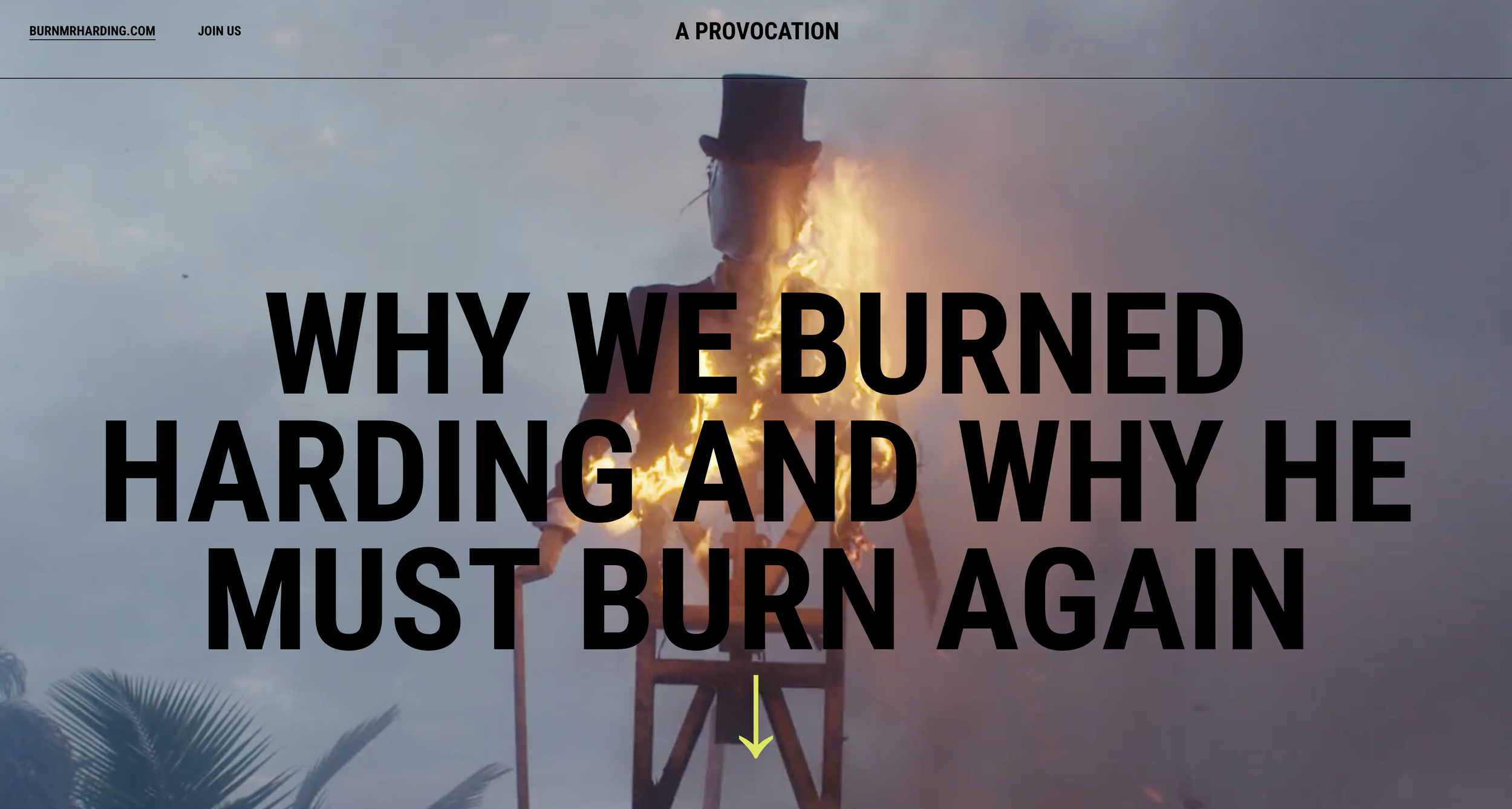
WHY WE BURNED HARDING AND WHY HE MUST BURN AGAIN
↓
more
more
ALL THE TALK...
ALL THE TALK...
hear the talk this year? That Harding’s returning to Crop Over, But isn’t being burned?
Or That someone MIGHT have burned him ALREADY — and if nobody did, somebody should?
Lots of Talk, and even more questions, but here’s the only one that matters:
why did this long-lost Bajan tradition disappear in the first place?
more
more
↓
WHERE HE COME FROM
WHERE HE COME FROM
Mr. Harding was born in the bowels of slavery, when many plantations let the enslaved mark the end of the sugar cane harvest with song, dance and rum — AN EARLY FORM OF CROP OVER. IT WAS in PART DERIVED FROM THE HARVEST HOME FESTIVAL IN ENGLAND.
ThIS EARLY INCARNATION OF CROP OVER carried on through Emancipation in 1834 — though FREEDOM WASN’T ALL IT WAS CRACKED UP TO BE. SEE, Barbados was so small that many of the formerly enslaved had no choice but to keep living and working on the plantations, sometimes in conditions worse than slavery itself. Now massa owed them nothing — not food, clothing, noR shelter — so the end of the harvest OFTEN meant months without work OR PAY. with THIS CAME PLENTY OF suffering and sometimes starvation.
This PERIOD CAME TO BE KNOWN AS the hard times.
Enter Mr. Harding. We don't know how or when, but just as in England's Harvest Home — in which a corn effigy was trotted out and paraded to celebrate another successful crop — the enslaved of Barbados would cart around a life-sized figure made of cane trash during their celebrations. Eventually, though, their effigy took on a rather distinctive image: that of a white plantation owner. In other accounts, he was modeled on the black slave driver. Either way, adorned in a black coat and top hat, he came to embody the plantation itself
— a subversive caricature of everything that oppressed the laboring masses.
THIS WAS ACCOMPANIED BY another LOCAL evolution: RATHER THAN PRESERVE THEIR EFFIGY LIKE THE FIELD WORKERS OF ENGLAND, THE FORMERLY ENSLAVED TOOK TO BURNING Harding, Not unlike another British tradition — that OF Guy Fawkes and Bonfire Night — OR other longstanding EFFIGY TRADITIONS AROUND THE WORLD.
IN THIS incendiary act, the formerly enslaved OF BARBADOS sought to ward off the hard times ahead, summon strength of spirit, and survive another season.
it could be argued that some of us wouldn’t be here had they not burned him.
(1) For more on the history of Harding, Please read our timeline, as well as the following articles:
↓
more
more
WHERE DID HE GO?
WHERE DID HE GO?
By the 1940s, following the riots of 1937 and the start of the march towards Independence, Crop Over had all but vanished from the Barbadian cultural landscape.
The festival would eventually be resurrected in the 1970s by Elombe Mottley, Julian Marryshow and others, as both an act of cultural reclamation and a way to draw tourists in during the slow summer months. Mr. Harding was also reintroduced, serving as a fiery climax to the festival following Kadooment.
The reincarnated folk figure quickly ignited the Bajan cultural imagination and found his way into all kinds of creative expressions, with no less than The Mighty Gabby winning the first road march in 1979 with his song "Burn Mr. Harding," and RED PLASTIC BAG WINNING HIS FIRST CROWN at PIC-O-DE-CROP ‘82 FOR HIS TAKE ON THE SUBJECT, “MR. HARDING.”
It didn't take long for Harding to become a controversial figure, however, with some worried that his burning would stoke racial tensions on our relatively peaceful island, and even scare away the tourists. During the finale of Crop Over 1982, Harding was pelted with stones and bottles, and the controversy reached a fever pitch, lighting up the airwaves and leading to much ink being spilled in the newspapers.
By 1983, that was the end of THE BURNING OF MR. Harding.
more
more
↓
WHERE DO *WE* GO?
WHERE DO *WE* GO?
There have been many calls and attempts to bring Harding back since then. In recent years, many artists and craftspeople have found creative and inspiring ways to play with the iconography of this nearly forgotten folk figure.
Burning him, however, remains a taboo topic.
But why? Are we not facing hard times today? Barbados, like other Caribbean nations, finds itself STARING DOWN A crisis which metastasized from our very own countryside, acres of mono-cropped cane that funded the industrial revolution abroad and the massive first world wealth that has largely left us behind with underdeveloped infrastructure and shocking rates of non-communicable diseases. This runaway capitalism — which, again, mutated in these fields and hills beyond recall before devouring the rest of the western hemisphere — has also accelerated global warming, spawning increasingly stronger hurricanes that race to our shores each year, just like the braided geopolitical and International economic crises we now face.
How many of these modern ills are systemically rooted in the sins of our plantation past? How does everything it has wrought continue to bear down on us today?
If ever we needed a symbol and a tradition to remind us of all we've been through, of all we continue to face, to root us deeper in who we are and must be, we couldn't ask for one more powerful than Mr. Harding.
So why aren't we burning him? Are we not mature and smart enough as a society and a diaspora to interrogate this symbol with the nuance it deserves? To find creative ways of exorcising our colonial hangover on a grassroots level, especially in a historical moment when our political leaders are seeking reparations from those abroad that profited from our dehumanization for centuries?
WITHOUT TRADITIONS SUCH AS burning mr. harding, we lose our living connection to our history of resistance and leaders such as cuffy, tony, nanny grigg and general bussa. Across the region, in countries such as Grenada and Trinidad and Tobago, other masquerade traditions don't hold back when it comes to acknowledging and expressing the defiance and turbulence they sprung from. Barbados similarly needs unbridled, uncensored and unrestricted forms of creative expression that allow us to carry forth the genetic memory of the practices our ancestors used to survive. Without them, this knowledge becomes the stuff of exhibitions and textbooks; vital and necessary, but only part of what we truly need to continue this journey.
Without traditions such as burning mr. harding, we violently sever oral histories and the nation’s generalized understanding of the forces that intertwined to transform barbados into the world’s first slave society and the birthplace of structural racism in the western hemisphere. consider the barbados slave code of 1661, the barbados plantation model, the unbroken ownership of drax hall, the fact that the EARLIEST KNOWN slave song TO BE TRANSCRIBED was DONE SO ON THIS ROCK, aS WELL AS countless other facts about barbados’ position as the laboratory in which chattel slavery was concocted. most of us don’t know one blasted thing about this history that continues to shape our present and future; but how could we when we squash and condemn the living traditions that pass this knowing onward? the government is to be commended for its concerted support of the LONG-BESIEGED pan-african community who’ve long sought to bring this knowledge to the fore, and for various new preservation initiatives, but there is so much more to be done in the commons, among everyday bajans. WE NEED COLLECTIVE WORK TO RAISE COLLECTIVE AWARENESS.
beCause HOnestly: do we really understand what happened here? What is still happening here?
Without traditions such as BURNING MR. HARDING — however transgressive — we rob younger generations of ancestral PRACTICE to ground themselves in and a real outlet for the depths of their feeling. Is it any wonder that without this, so many of them, left behind by society, have nowhere else to unleash this feeling than through the barrel of a gun? how many of us have lost loved ones long before bullets came into play? THESE LEVELS OF nihilism AND the SENSELESS, BLOODY VIOLENCE it spawns ARE unprecedented in MODERN Bim.
WITHOUT TRADITIONS SUCH AS burning mr. harding, we LOSE OUR SENSE OF NATURE — SOMETHING WE ARE A PART OF, NOT SOMETHING WE EXPERIENCE OUTSIDE OF OURSELVES — AND INSTEAD MARCH BLINDLY ON EXTRACTING FROM AND IGNORING WHAT THE EARTH IS TELLING US, UNAWARE THAT OUR HOMEGROWN PLANTATION LOGIC IS RESPONSIBLE FOR THE ECOLOGICAL COLLAPSE NONE OF US CAN OUTRUN.
Without traditions such as BURNING MR. HARDING, our culture becomes watered down and toothless, ever more beholden to optics and the seemingly almighty power of the tourist dollar. Entertainment at most, but not art in the slightest, and certainly not ceremony. Is it any shock that so many people are complaining about the quality of the music this year and saying that crop over is dying? IS IT Any shock That the Prime Minister has to make the admirable effort to call for the preservation of Calypso and Soca because THEY ARE rapidly disappearing from THE SEASON and being supplanted by OTHER GENRES AND foreign acts? Is it any surprise that so many people were disappointed that iShowSpeed’s trip here was so staged and sanitized as compared to his visits to neighboring islands where he experienced real and rooted culture, not performance?
WE ARE LOSING OURSELVES.
Is it any wonder that the voices calling for a cultural revolution in Barbados are getting louder?
Let them get louder still.
Culture — real, living culture — is not something that can be funded, preserved, mandated or “PERMITTED” by the government. This is not to say that the National Cultural Foundation and the ministry of culture serve no purpose. Far from. But without them, would there even be a Crop Over? Go to many other islands and culture and masquerade practices spring first from the people. Mr. Harding is one such practice, previously central AND ORGANIC to Crop Over in its various incarnations, yet the very mention of burning him invites fear, heavy-handed regulation and swift comments from various authorities of “No! No! No! You can’t do that!!!”
And so, we make do with other representations of him. MOST are quite clever and INDEED TREMENDOUSLY welcome, but IN THE WORDS OF KAMAU, “IT IS NOT ENOUGH.” without the ongoing practice of actually burning him, we run the risk of neutering the ritual and sapping it of meaning.
Worse yet, if we eventually do “allow” some form of burning of harding which is devoid of his complicated history and a true and full sense of what he embodies, we risk running afoul of forces far greater than any of us can see.
We need a return to something at the core of our struggle and triumph, to remember who we are, WHO WE WISH tO BE, and what we are actually celebrating. Burning Harding served a real purpose for our forbears, and it must for us as well.
Burning Harding, done correctly, is an act of healing.
It’s because of this that some of us gathered at the outset of this season of emancipation to burn him once again for the first time in many, many years. We did so with deep reverence for those who burned him before us and in renewed defiance of what they faced — forces which we now FACE as well, albeit in insidious new forms.
There is A GREAT DEAL more to be said about what transpired and was set in motion THAT DAY, but that will come in due time. For now, please know that We will continue to burn him and, moreover, that we invite you to join us!
TOGETHER, WE MUST spark an overdue cultural renaissance in Barbados.
IT IS SIMPLY WAITING FOR US TO LIGHT THE FUSE.
(2) To be clear, “correctly” means safely, INclusive of everyone, regardless of race or status, who is truly committed to equality and the dismantling of the systems of power that continue to oppress the underprivileged and the planet. And Most importantly, Harding must be burned with equal parts joy, reverence, And a profound acknowledgement of the Barbadian history at the heart of this incendiary act.